The AI Arms Race: Why Property Management Cybersecurity Must Evolve Faster Than Ever
Artificial intelligence (AI) is transforming the property management industry. Leasing teams use AI to respond to prospects faster, maintenance teams...

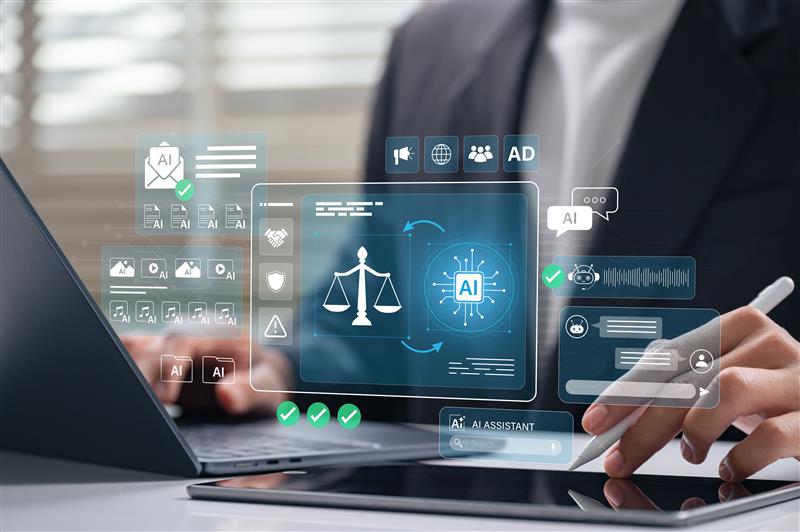
As Artificial Intelligence (AI) adoption at work continues to rise, so do concerns about how AI will transform the workplace and society at large. From fears that AI will eliminate or replace millions of jobs to the potential environmental impacts of generative AI data centers, this emerging technology continues to spark discussion about the ethics of AI and its growing presence in our lives.
While this topic is constantly evolving and new developments rapidly shift the conversation, here are some of the most pressing ethical issues facing AI in the workplace in 2026, and how they might be addressed by future innovations, policies, and individuals.
Can AI really replace your job? For some industries, a future transformed by automation seems likely—projections by the McKinsey Global Institute estimate nearly 30% of hours worked today could be automated by 2030. And AI may already be contributing to reductions in entry-level hiring across multiple industries. As routine tasks and even entire roles can be offloaded to AI models, the nature of work itself may shift as corporate adoption of AI tools grows.
However, like other technological advancements of the past, the McKinsey research suggests that post-automation employment levels are likely to remain stable as roles emerge to replace those automated or transformed by AI.
Companies are already increasingly targeted by cybercriminals, and enterprise-level AI systems can leave an organization more vulnerable to threats. In addition to AI-assisted cyberattacks, cybercriminals may attempt to extract sensitive proprietary data from AI systems, poison training data, or manipulate systems in ways that alter their behavior. Furthermore, AI can also contribute to breaches of privacy—whether through extensive AI-enabled employee monitoring software, or a security breach of a proprietary AI system itself, resulting in sensitive employee or customer data falling into the wrong hands.
Agentic AI is a system of machine learning “agents” that mimic human decision-making to solve problems in real time. While still evolving, agentic AI systems may eventually be able to perform autonomous, complex workflows without human intervention, such as handling customer service inquiries or placing supply chain orders after analyzing inventory levels.
As these models develop more sophisticated decision-making abilities, it raises the question of who is responsible when something goes wrong. And things can and do go wrong—agentic AI can make poor decisions due to incomplete data, conflicting parameters, or inadequate safeguards. Depending on the task, mistakes can result in financial losses, operational disruption, or the spread of harm or misinformation.
All AI systems are trained on vast amounts of human-created data. The more data the AI receives, the better it can perform its intended function. However, humans are subject to both implicit and explicit biases. These biases may be learned and reproduced by AI systems, leading to potential harm or even discrimination.
For example, if a Human Resources team uses AI to screen resumes and the system is trained on historical hiring data reflecting demographic bias, the AI may unintentionally perpetuate that pattern, rejecting qualified candidates from underrepresented groups.
AI hallucination is a phenomenon in which an AI system, typically a Large Language Model (LLM), generates a convincing response that is factually incorrect, misleading, or unsupported by reliable sources. LLMs rely on pattern recognition and probabilities, and when exposed to training data that is too broad, vague, outdated, or contradictory, a hallucination is likely to occur. Without proper oversight, relying on inaccurate AI output can have serious consequences. While AI accuracy continues to improve, AI hallucination and inaccuracies are still a problem—a late 2025 study by the BBC and European Broadcasting Union found that AI assistants misrepresented news content 45% of the time.
AI tools can boost productivity and efficiency by automating tasks such as data analysis, transcription, generating code, and drafting communications. However, heavy reliance on AI may come with an unintended consequence—skill atrophy. Like how relying on GPS can weaken navigational skills, using AI tools is a form of cognitive offloading that may contribute to atrophy of critical thinking, reasoning, and problem-solving skills. This area is still being studied, but early research—like this MIT study indicating participants who used an LLM to write essays demonstrated reduced ownership and recall ability of their work—has worrying implications for the future of many industries as AI usage becomes more mainstream.
AI is already transforming workplaces and industries worldwide. The speed at which AI is developing means the nature of work will likely look completely different in 5-10 years, or even next year. Ongoing discussions about AI ethics will remain important as developers, organizations, and employees adapt to this powerful technology and its application in the workplace.